
September 17, 2011
Computer Output Microfilm
Computer Output Microfilm is the rarest of 16mm roll film types (ironically Computer Output Microfilm is a very popular form of microfiche). Because of the nature of most COM reels not having regular edges like normal 16mm roll film, converting COM rolls into digital image can be quite a challenge. Thankfully, Generation Imaging has tons of experience working with all kinds of Computer Output Microfilm.
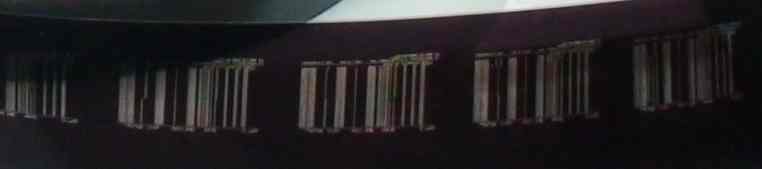
An example of Computer Output Microfilm
If the COM roll is blipped (small markers on the outside of the frames) and the frames have fixed sizes and are equidistant from each other, although the scanner operator must be highly experienced and the setup time is lengthy, it is theoretically possible to scan the Computer Output Microfilm without problems.
If the COM roll does not have blips, the highly skilled scanner operator must used advanced detection algorithms to attempt to find a sense area and setting to capture each frame by itself. Again, the Computer Output Microfilm must pretty much be perfect to pull this method off.
If none of the above methods will work, the expert scanner operator will have to scan the COM images as strips of frames. By padding an overscan and setting the backup, the operator can assure that no frame is missed. However this method requires post-processing: the frames must be manually cropped or split to create individual frames.
Generation Imaging offers scanning solutions for converting COM reels to PDF, TIFF, or JPEG. Please contact us today if you need this type of roll film to be converted to digital images.
September 14, 2011
Info About Computer Output Microfilm and COM microfiche
Computer Output Microfilm is the process for transferring data from electronic media stored on computers to 16mm microfilm or microfiche.
What is the machine which creates this? Using lasers and a processor, the data from the PC is copied to microfilm or microfiche. The fiche or film is then developed after it is exposed to light.
Computer Output Microfilm is used a solution for large organizations that want to see a reduction of paper.
It also provides away to preserve records for archival purposes.
Computer Output Microfilm and COM fiche can be converted to digital image via microfiche scanning, a service that Generation Imaging offers.
Digital images save even more space and takes COM systems to the next level, sort to speak.
Converting Computer Output Microfilm to digital image is useful for organizations who need:
- computer printouts
- reports, such as tax assessment documents, which have many pages
- a large distribution of images is required
- Images must be transferred or copied
By the way, I know how awkward it sounds to say Computer Output Microfilm and calling it COM fiche (which is similar to saying ATM machine). The correct terms should be Computer Output Microform, but hardly anyone in the industry uses microform (which can be microfiche, microfilm, or aperture cards). It could be why so many people get all three confused.
Anyway, please contact Generation Imaging for a COM microfiche scanning solution. G.I. scans all sorts of analog media, so don’t hesitate to ask us if we can help you in any way.
September 13, 2011
Reselling Microfiche Scanning Services
Reselling microfiche scanning services is an excellent way for your company, organization, or you to have access to a stream of revenue without investing in equipment, labor, office space, training, or liabilities. For example, let us say you work for a litigation company and one of your clients- in addition to needing documents converted to PDF- also has a collection of microfiche containing payroll records. Let us also assume that the set of fiche contains 1,000 cards.

It doesn’t make sense to perform the microfiche scanning on your own for the following reasons:
- Cost. Why buy a new microfiche scanner for $65,000 to digitize something worth around $4,000?
- Inferior scanners. There are scanners that are cheap (like $10,000) but what type of quality would you expect from low level camera technology?
- Labor, training, workflow. Do you really want to incur money up front costs to expand your company just to handle 1000 COM fiche?
Anyway, after you spend some time investigating all of these options and have meetings about the feasibility of your company doing the microfiche scanning, you will realize that it is more efficient to outsource the microfiche scanning.
Since Generation Imaging is a wholesale service bureau you will get a below market conversion price, which will give you room to add on to the price to your end client, i.e. reselling the microfiche scanning service. After all you are the one responsible for taking care of your end client, you are taking the risk, and you will be the one servicing the end client.
Generation Imaging can be your silent partner for reselling microfiche scanning services, or if you totally don’t want to get involved you could simply have us go direct and we’ll give you a commission- it’s your choice.
September 12, 2011
Another County Digitize Negatives to Preserve Records
Seems like everyday, another organization makes a move to digitize negatives to preserve historical records. This is a good move when you consider the benefits when you digitize negatives from microfiche cards. Microfiche with historical records are not easily accessible by the general public and they run the risk of deterioration and loss. If you digitize negatives from these microfiche, these issues go away.
The best time to digitize negatives from microfiche cards is before they begin to deteriorate. When this happens, the microfiche begins to lose quality and will eventually become useless. The precess to digitize negatives from these microfiche should start way before this decomposition has a chance to take place. The older the microfiche, the higher the risk of decomposition, although other conditions may also contribute. It is better to digitize negatives early to preserve quality and information.
Historical records hold an irreplaceable value. The ultimate step to digitize negatives from the microfiche will ensure that the information is preserved. Also digitize negatives allow easy access and distribution of the information. With this, when you digitize negatives you increase the value of the records and add layers of protection to the system.